NC colleges say they’re ready to tackle COVID this fall. Some on campus aren’t so sure
There’s a sense of déjà vu at North Carolina’s universities as they bring back thousands of students and employees to campus just as a new, highly infectious strain of coronavirus surges across the state.
Campus leaders say they are more prepared and adaptable than last year. They’re asking students and employees to get vaccinated, mandating masks inside and testing the unvaccinated regularly.
Still, some faculty and students fear that isn’t going to be enough to keep campus communities safe this fall.
“I will be very surprised if we get through this semester without shutting down,” said Sue Estroff, professor of social medicine and anthropology at UNC-Chapel Hill. She is a member of the UNC-CH Faculty Executive Committee.
“I hope I’m wrong, but I think you’ll find very few people who feel differently,” Estroff said. “And the ones who won’t say are the ones making the decisions.”
On the Chapel Hill campus, many are concerned that vaccines aren’t required, dorms and classrooms will be at full capacity and students will pack the stands at football games.
“We miss our students, we miss our colleagues and we understand the difference in the quality of education,” Estroff said. “There’s a bigger reality out there: It’s an uncontrolled, very dangerous viral strain.”
The UNC System has issued guidance for its campuses across the state, but chancellors have the authority to tailor their strategies based on what’s happening in their communities. But Estroff said politics from “the folks down the hill” at the UNC System office and Board of Governors also complicates things.
“The pressure to behave as if we weren’t in the midst of a second surge of the pandemic is huge,” Estroff said. “I wish it weren’t that way. I don’t think any of us is fooled by this.”
At a campus meeting Wednesday, UNC-CH Chancellor Kevin Guskiewicz described mitigation strategies and touted vaccination numbers, noting that 84% of students have attested that they are vaccinated.
Meanwhile, the university reported its first COVID-19 cluster of the semester the same day.
But Guskiewicz said he’s confident the university will get through the semester successfully.
“We don’t believe that we have to choose between safety and in-person learning,” he said. “We can do both with the right approach.”
Guskiewicz said UNC-CH has “no intention of pivoting to a remote learning environment or sending our students home.”
Excited, but anxious, students
N.C. State University Student Body President McKenzy Heavlin said the vibe from students in Raleigh is that they’re excited, but also anxious, as they come back to campus. More than worrying about getting COVID-19, they fear that their lives could be upended again if N.C. State reverts to online learning and kicks students out of dorms like it did last year.
Heavlin thinks that’s a valid concern with the delta variant and students converging from all over the state and nation. But he’s been meeting weekly with university officials who are working to make sure they have a safe, in-person semester.
“I think the chance that it’s a repeat of last year is really low if students follow the mandates and get vaccinated,” Heavlin said.
Students will still go out to bars, throw parties and get dinner with their friends. Fraternity and sorority recruitment at NCSU and UNC-CH will be a combination of in-person and virtual events this year.
However, students need to be aware that we’re still in a pandemic and that COVID-19 is still spreading, Heavlin said. And it’s on them to make good choices.
“You can go do recreational things,” Heavlin said. “But that is increasing the likelihood that you’re going to get it, which increases the likelihood that N.C. State might have to pivot.”
UNC-CH junior Ray Palma said he thinks universities are in a different place than last fall, when schools had ambitious reopening plans but there was no vaccine. The UNC System’s “get vaccinated or get tested” rule is compelling for students, he said, because the unvaccinated won’t want to get tested at least once a week.
“I do think it is a good incentive for students who haven’t chosen to get vaccinated or are still on the fence,” Palma said.
Though Palma said he’s heard rumors and speculation of fake vaccination cards, he doesn’t know how legitimate that is.
“Maybe it happens, but if it does on a small scale,” he said. “I would say it’s not widespread whatsoever.”
As the president of the UNC Association of Student Governments, Palma has been meeting with student leaders throughout the summer. They’ve talked about how it’s important that campuses like UNC Wilmington and Western Carolina are able to have different policies than, say, East Carolina or UNC-CH.
“A one-size-fits-all policy would not work for a lot of campuses,” Palma said. Having some flexibility worked last year, as the majority of institutions were able to keep campuses open with hybrid classes and students living in dorms.
How campuses are navigating COVID
College students are now moving into dorms, apartments and residence halls. They’ll soon be taking in-person classes with labs and classrooms at full capacity and no social distancing. Most rules are the same for students, faculty and staff across the UNC System’s 16 universities.
Individuals must wear face masks indoors, students and employees are asked to show proof of vaccination and unvaccinated students must participate in reentry and regular surveillance testing.
Schools also have dorms set up as designated isolation space for students who test positive and quarantine space for unvaccinated students who are exposed to the virus.
Faculty are prepared to offer their course materials online for students who get sick or miss class to isolate or quarantine. And the universities will maintain COVID-19 data dashboards to report positive cases, testing numbers and available quarantine and isolation space.
East Carolina University and Appalachian State University also are utilizing wastewater testing to quickly identify positive cases in residence halls.
“I cannot stress more urgently how essential it is for our continued in-person experience that we all get vaccinated against COVID-19,” App State Chancellor Sheri Everts said in her most recent campus message.
She reminded students how the vaccine is the single most effective tool at slowing the spread and preventing serious illness or death. That message carries a bit more weight at App State, where a student died last fall from COVID-19 complications.
Private universities require vaccines
Though UNC System schools have set up vaccine clinics at campuses and promoted the “get vaccinated or get tested” policy, they are not requiring students or employees to be vaccinated. The system has cited a “lack of clear legal authority” in the matter and advised the campuses that only the North Carolina Commission for Public Health may mandate immunizations for college students.
But some faculty have questioned the assertion. And that’s not the interpretation of most of North Carolina’s private universities.
Duke University, Shaw University, Elon University and other private schools are requiring students to get vaccinated. They make exceptions for those with medical or religious reasons.
Jameliah Pinder, a rising junior from Nassau, Bahamas, majoring in political science and English, is excited to be back at Shaw University in downtown Raleigh this fall. Back in class, back with her friends, back to enjoying campus events such as homecoming.
“Last year, homecoming was a lot of computer screens and a lot of Zoom,” Pinder said. The plan this year is to hold homecoming on campus like in pre-pandemic days.
“I’m looking forward to a lot more in-person events, a lot more physical presence versus virtual presence. ... That’s what I’m hoping for,” Pinder said.
In addition to being vaccinated, all students at Shaw must have a negative COVID-19 test three to five days before move-in to even get a dorm room key.
When the school emailed students that vaccines and tests would be required, Pinder said, “I think a lot of people were shocked, and a lot of them said, ‘Oh, I’m not going back to Shaw University.’
“But at the end of the day, the statistics prove that vaccinations help. With that understanding and that knowledge, our students are wise enough to make a decision that suits them.”
.JPG "RAL_081221_UNCmovein_JMW_02 (1).JPG")
Vaccination rates vary at public schools
A week before classes start, about 85% of UNC-CH students have told the university they are vaccinated. About 3,200 have not yet attested to being vaccinated, and they will be required to be tested weekly unless they upload their vaccination information.
About 64% of staff and 92% of faculty reported being fully vaccinated, according to UNC-CH.
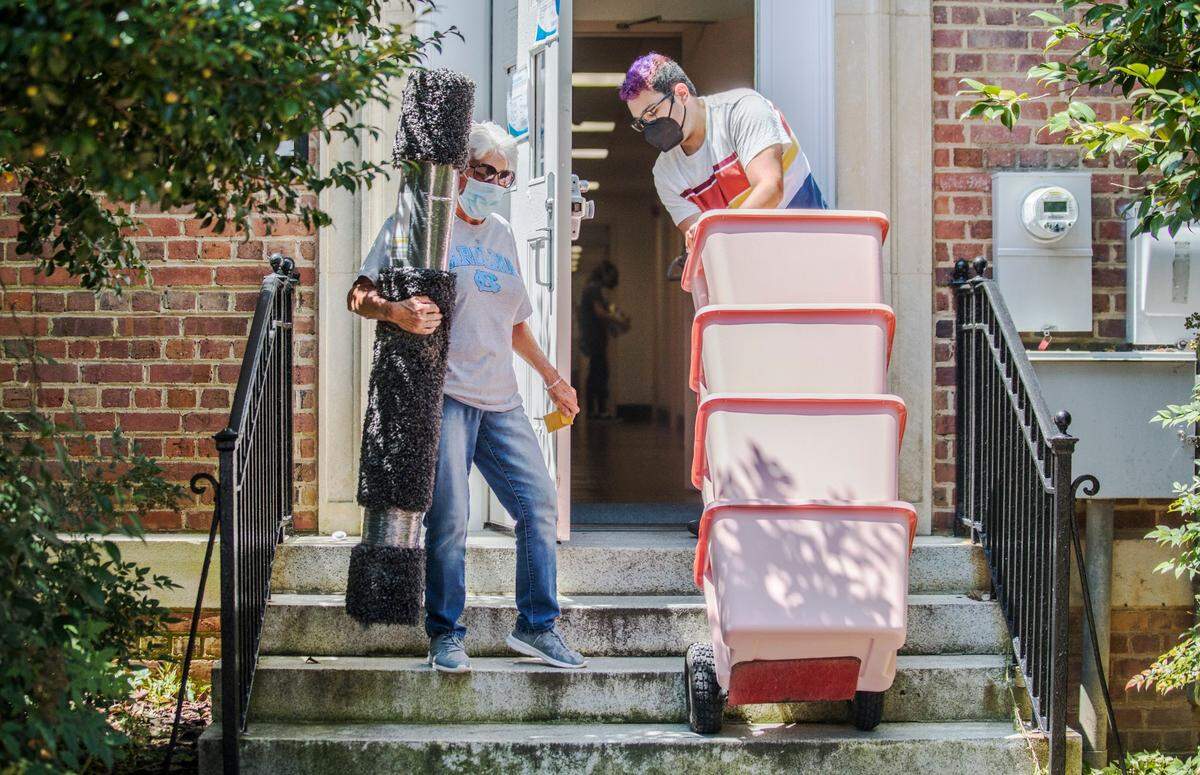
Students and parents arriving for the first day of move-in on the Chapel Hill campus Thursday seemed more at risk for heat exhaustion than COVID-19.
The parking lot outside Craige Residence Hall was jammed with cars, their doors and trunks gaping, their dash thermometers reading 100 degrees. A father pushed a mini-fridge on a hand truck, a heavy duffel bag across his back. A brother carried a mini-fridge on his shoulder. In came all the necessities of building a home away from home: towels, blankets, stuffed animals, full-length mirrors, plastic desk lamps.
Chancellor Kevin Guskiewicz and his wife, Amy, welcomed some of the new arrivals to campus and chatted with their parents and siblings. Student Body President Lamar Richards greeted some, as well.
Freshman Faith Maksoud of Morganton was delivered to Craige by one of her brothers, Jared, and her stepfather, Kent Holcomb. The family is keenly aware of the surge in COVID cases, as Maksoud’s mom, a doctor, oversees the COVIC-19 care unit in a hospital in Lenoir.
Maksoud said she knows there’s a chance that case numbers will spike and students could be told to leave, but she and her brother already have a plan. He’s going to school in Chicago, and if both their campuses shut down, they’ll look for an apartment together in Chapel Hill.
“I’d be disappointed,” she said, but she didn’t think twice about whether to come.
At N.C. State, more than 25,000 or about 54% of the campus community have either been fully vaccinated on campus or have uploaded their proof of vaccination. The university has seen a flood of vaccination status uploads since announcing the “get vaccinated or get tested” rule and expects that number to continue rising.
As of Aug. 12, approximately 1,685 N.C. Central University students and employees voluntarily reported that they have received a COVID-19 vaccination. NCCU enrollment was about 8,000 in Fall 2020.
The vaccine is the most critical element of Duke’s strategy this fall, which is why it announced the requirement months ago, according to university spokesperson Michael Schoenfeld. He said about 1% of students who will be on campus are not vaccinated and about 90% of employees are vaccinated.
“The vaccines are safe, they’re effective, they’re free and they are by all accounts ... the key to having a productive and close to normal semester, not just for the university but society,” Schoenfeld said.
Duke also will continue its aggressive testing strategy. Vaccinated students will be tested weekly and unvaccinated students will be tested twice weekly.
All of Duke’s classes will be taught in person, face masks will be worn indoors and students will have roommates in the dorms this year for what will feel like a fairly normal semester. But that could all change as the university continues to monitor local public health conditions, particularly with the COVID-19 delta variant.
“Clearly there are challenges that we are all going to face, that perhaps we didn’t anticipate even a month ago,” Schoenfeld said. “But we have a lot of experience adapting, pivoting, and being flexible over the last 18-19 months, and that’s what we’re going to continue to do.”
On Friday, even before classes started, Duke reported two COVID clusters involving 29 Duke medical students and seven members of the university’s women’s field hockey team.
COVID spread in the community
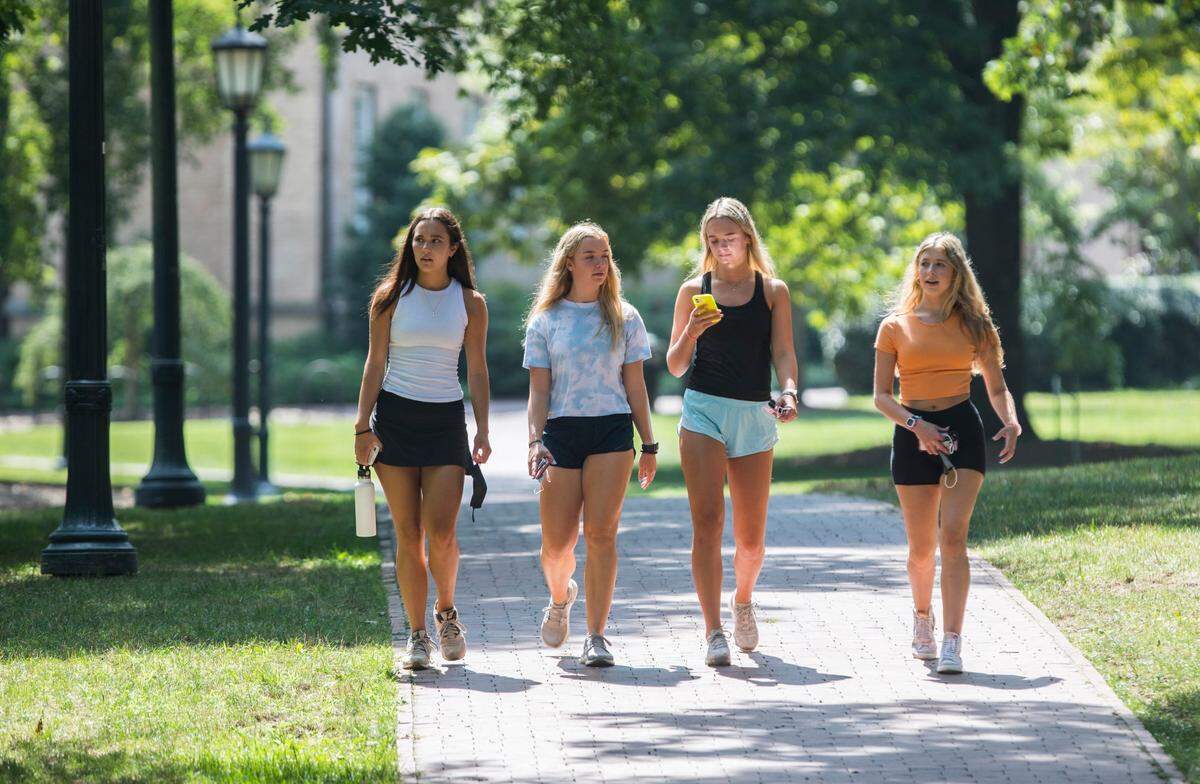
Across North Carolina, more younger adults are getting COVID-19 and being hospitalized compared to earlier in the pandemic. Since mid-July, 18- to 24-year-olds have been infected at rates higher than any other age group. The recent surge of cases is driven largely by the more infectious delta variant.
“We in North Carolina and really the whole country are not in a very good place right now,” said N.C. State professor Julie Swann. “The delta variant is about twice as infectious as what was circulating last summer.”
Swann, who has worked with the federal Centers for Disease Control and Prevention, is part of a team of researchers modeling COVID-19 spread in K-12 schools and universities.
She said one problem is that while vaccinated individuals’ symptoms may be less severe, they can still get infected and pass it to others who are more susceptible to serious illness. As of July 1, about 40% of North Carolinians have no protection from the virus, because they haven’t had COVID-19 or aren’t vaccinated, Swann said.
As of Aug. 11, less than half of North Carolinians were fully vaccinated, according to the state.
Counties in the Triangle report some of the highest vaccination rates in the state, with Orange County leading at 76% of its population being full-vaccinated.
There is a concern that universities could lead to transmission as groups of people mix together, and infections on campus are inevitable, Swann said. But masks, vaccines and weekly testing will make a huge difference.
In response to the surge, Raleigh, Durham County and Orange County have ordered mask mandates in public spaces and businesses. That means students should be wearing masks at restaurants, bars and house parties.
Last year, COVID-19 mostly spread through off-campus activity like social gatherings and large parties, particularly associated with Greek life. People could report violations of the campus standards and local mandates. But there are no gathering limits this year. And enforcement will likely be a challenge again.
“We know college students will be in environments unmasked,” Swann said. “They will participate in social activities where not every single person has a mask on.”
It will take at least four weeks to start to understand what’s happening on campus, Swann said.
She expects universities to change policies as they figure out whether things are better or worse than they thought.
This story was originally published August 13, 2021 at 5:27 PM.