It’s been a big year for job announcements in NC. He played a big role in landing them
READ MORE
The News & Observer Tar Heel of the Month
The News & Observer’s Tar Heel of the Month honors residents who have made significant contributions to the Triangle, North Carolina and beyond. At the end of the year, a Tar Heel of the Year is named. Do you want to nominate someone? Email metroeds@newsobserver.com.
Expand All
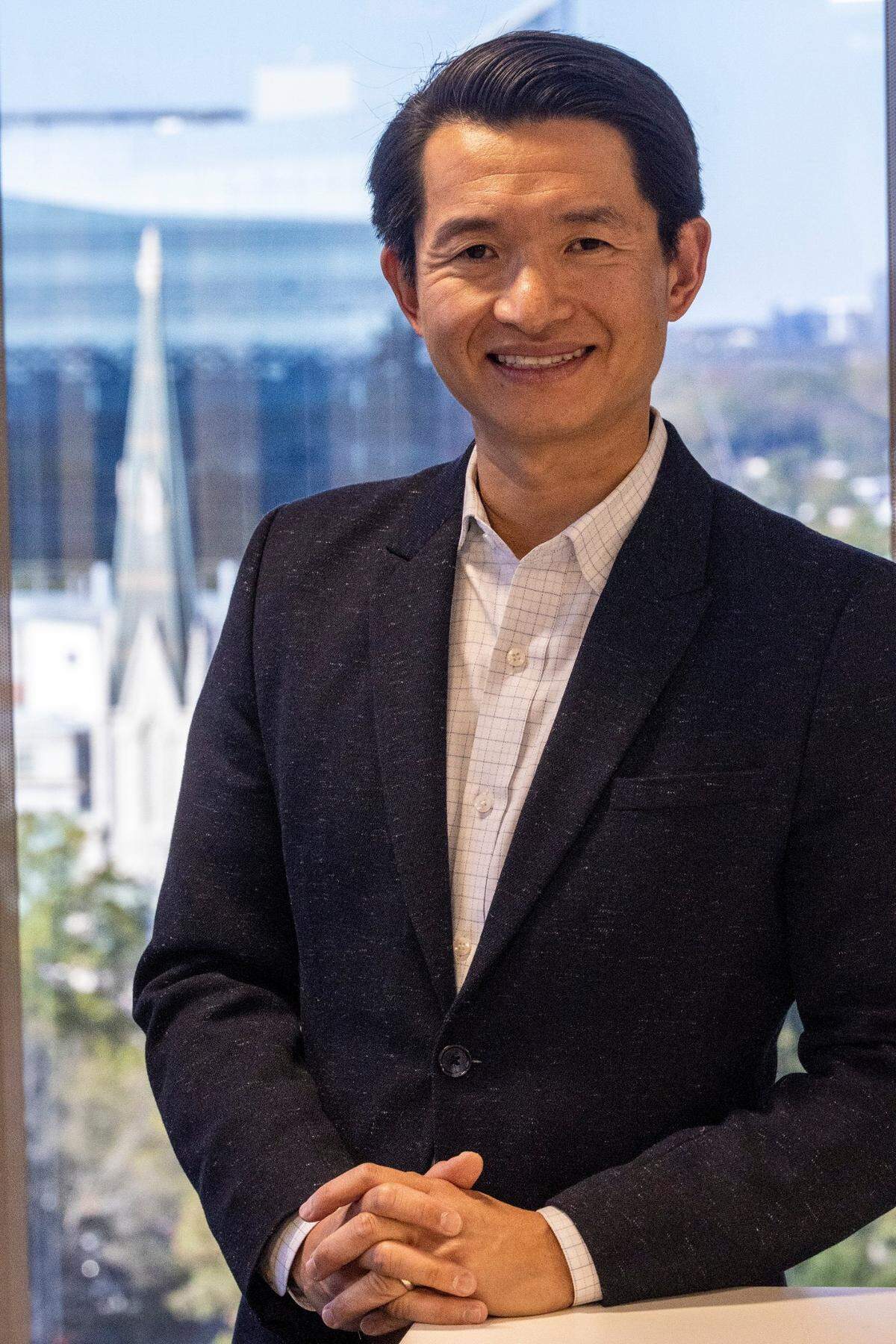
You may not know Christopher Chung, but you may have read the big headlines he’s helped generate. Apple coming to Wake County. Toyota coming to Randolph County. VinFast and Wolfspeed will bring big jobs to Chatham County.
Chung has also coordinated dozens of less-heralded job announcements that many predict will strengthen North Carolina communities from the mountains to the coast.
As CEO of the Economic Development Partnership of North Carolina (EDPNC), he heads the public-private partnership that attracts new companies to the state and encourages existing companies to expand here. Business recruitment isn’t the organization’s only role, but it’s the one that gets the most attention since it started in 2015.
“It involves a lot of different players all playing their respective roles at the right time during that company’s decision-making process,” he said.
Chung joined EDPNC in its first year, and thus, he’s been uniquely positioned to set the new organization’s direction. Many stakeholders play their part in attracting major companies, from the state Department of Commerce to the project sites themselves.
But Chung is often the first point of contact for businesses curious about growing.
“I think you have to give credit to the person who’s leading the charge,” said Tony Copeland, the state commerce secretary from 2017 to 2021. “Who could complain where we are right now?”
Chung, 46, grew up in a suburb of Columbus, Ohio, the child of Taiwanese immigrants. After graduating from Ohio State University in 1998, he immediately started working in business recruitment, first in his home state, before working in Missouri and then North Carolina.
As North Carolina and the rest of the country emerge from the pandemic, the state has had a banner year for major industry announcements. For Chung’s role in helping boost the state’s economy, he’s The News & Observer’s Tar Heel of the Month, which honors people who have made significant contributions to state and the region.
Chung spoke with The N&O about how to sell North Carolina to businesses to what books and quotes inform his work.
This conversation has been edited for clarity.
What elevator pitch do you give businesses considering North Carolina?
Chung: I get that question a lot, and frankly, I actually don’t really subscribe to that notion. Only because of this: Every company is really different. Even companies within the same industry have differing needs.
Generally speaking, we’re going to talk about North Carolina from a workforce standpoint. Certainly, the production of talent by our two-year colleges and our four-year universities, our (Historically Black Colleges and Universities), how they continue to produce graduates into the workforce. That is a big part of what we’re going to talk about.
We’re going to talk about transitioning military service members who are leaving active duty and reentering the private sector. We’re even going to talk about in-migration, not immigration, of people moving here from other parts of the United States, which continues to deepen and broaden the type of talent that employers have access to.
So, workforce is almost always going to be part of that pitch. And then depending on whether it’s a manufacturer, we might talk about energy costs being some of the most competitive. We might talk about our tax rates, our regulatory system. We might talk of course about quality of life, if they’re going to be moving people here from somewhere else in the country.
What’s a mistake you made during your first business recruitment job in Ohio? And how have you learned from it?
Chung: I think when I was a front-line business recruiter, I realized belatedly the importance of getting that right ensemble of partners around the table that help collectively pitch a company, rather than thinking that’s all on me. It wasn’t an ego thing, like I’m the only one who can make it happen, I think it was just a lack of awareness that I could lean on these different partners for help.
To harness that collective voice of the Ohio team in ways that I since hope I’ve gotten much better at.
What addition have you brought to the state’s efforts to recruit businesses?
Chung: I was hired in part to build up an organization that never existed before in North Carolina. And frankly, when it was created, there was a lot of skepticism or doubt, like, “Hey, why is this necessary?” “How will this be an improvement on the old status quo?”
And I feel like after eight years, we still have plenty of room where we can always be better, but I feel like we’ve won the respect and credibility with a lot of the audiences, including groups that might have been doubtful about this concept eight years ago.
I would like to think that one of the things that we have elevated is the state’s ability to be extremely collaborative and to bring the right concert of partners to the table with each of these individual pursuits that we get the chance to compete for.
What project are you most proud of?
Chung: Every project is important because, ultimately, we work all across the state. So, a company that creates 2,000 jobs in a place like Raleigh, that’s great. And that’s worth celebrating as much as we can. But in a more rural area, it might be that 200 or 300 jobs can have that same degree of impact.
There have been projects that I’m really glad that North Carolina won, because for a long time, North Carolina has not been successful landing those types of users. For a long time, North Carolina would see its Southern competitors land a lot of these automotive investments and North Carolina always seemed to be missing out on it. So, I’m glad that that’s no longer a cloud that hangs over the head.
Some are skeptical of these economic projects, either because of the change they may bring or the tax break incentives companies receive. What’s your response to them?
Chung: In 25 years of doing this type of work, I always welcome the conversation, because I understand not everyone agrees with this particular type of economic development. And not every community wants to see that. And that’s certainly their prerogative. I think, as a state organization, we never want to force a company into a community that doesn’t embrace that because that’s not good for the company long-term either.
North Carolina has learned that over the past half century — being a state that was heavily-weighted in tobacco, textiles, furniture — that we don’t know what industry sectors are going to be dominant in 25 years from now. And so, it’s a way that you diversify against not having your eggs too much in one basket. It’s really no different than what they advise us for retirement planning, right? Spread out in stocks, bonds, lots of different industries. Economies really should try to do the same thing.
What books have informed your work?
Chung: The one that jumps out is “The New Geography of Jobs” by Enrico Moretti, the professor at Berkeley. It talks about places like the Triangle that are featured in terms of the types of jobs being created in this region, and what that translates to in terms of the quality of jobs that exist within the rest of the economy.
“The Factory Man” is a really good one by Beth Macy. It’s actually about the Bassett family in Virginia. They’re a big furniture name. It talks about how furniture used to be the lifeblood of these towns in Southwestern Virginia and north-central North Carolina, and how global competition and outsourcing and offshoring really affected these industries.
(The third book Chung picks is “Bad Blood” by John Carreyrou about the Theranos and Elizabeth Holmes scandal).
What would have happened had Theranos approached Missouri or Ohio or North Carolina at (Theranos’s) peak? ... I think a lot of economic development groups probably would have fallen all over themselves to land and announce that company, and that would have been a casualty of the eventual implosion of a company.
Do you have a favorite quote?
(Chung mentions a few, including the following quote often attributed to Mark Twain:)
“Twenty years from now you will be more disappointed by the things that you didn’t do than by the ones you did do. So throw off the bowlines. Sail away from the safe harbor. Catch the trade winds in your sails. Explore. Dream. Discover.”
Chung: So I was very happy in Ohio, where I’m from originally. So, to take the job in Missouri without any roots or connections there on only the vision of an organization. Then North Carolina, similar situation with no roots or connections here. Came here eight years ago, basically because some people thought I had success with a similar model and asked if I’d be willing to try.
I think to some extent, I took a bit of a chance on both of those, and I’m really glad I did. I think my life would’ve turned out very differently had I turned either one down.
This story was produced with financial support from a coalition of partners led by Innovate Raleigh as part of an independent journalism fellowship program. The N&O maintains full editorial control of the work.
This story was originally published November 23, 2022 at 5:45 AM.