NC Leandro case timeline: 32 years of legal battles over a ‘sound basic education’
AI-generated summary reviewed by our newsroom.
- Leandro lawsuit spans 32 years, challenging state duty to provide schools.
- 1994 suit by five low-income counties launched legal fight over equity.
- 1997 N.C. Supreme Court affirmed a constitutional right to basic education.
READ MORE
The Leandro case & NC public schools
Since 1994, the long-running Leandro school lawsuit has seen the courts go back and forth about what it means when the North Carolina constitution says “equal opportunities shall be provided for all students.” Meanwhile, state leaders have grappled with how to provide a “sound basic education” for North Carolina’s 1.5 million public school students.
Expand All
For 32 years, North Carolina leaders have struggled to define what it means when the state constitution says “equal opportunities shall be provided for all students.”
The long-running Leandro school lawsuit has seen the courts go back and forth on what the courts can do to provide a “sound basic education” for North Carolina’s 1.5 million public school students. Thursdays ruling by the N.C. Supreme Court marks the latest and potentially final chapter in that fight.
Here’s a timeline of events in the Leandro case:
Right to ‘sound basic education’
May 1994: School districts in five low-income counties (Hoke, Halifax, Robeson, Vance and Cumberland) and families sue the state, claiming that children are not receiving the same level of educational opportunities as students in higher-income counties.
The lawsuit is officially known as Hoke County Board of Education vs. State of North Carolina. It’s unofficially known as the Leandro case because the Leandro family was the first one listed as a plaintiff in the lawsuit.
July 1997: N.C. Supreme Court unanimously rules that the state constitution guarantees every North Carolina child the right to a “sound basic education.” The case is assigned to Wake County Superior Court Judge Howard Manning Jr. to determine if the state is meeting that obligation.
April 2002: Manning rules the state is not providing students across the state with a “sound basic education.” Manning orders every public classroom in the state to have a caring, qualified teacher, and every school to have sufficient resources and be led by a competent principal.
July 2004: The N.C. Supreme Court unanimously rules the state’s efforts to provide a sound basic education to poor children are inadequate. But like Manning, the court leaves it up to lawmakers, the governor’s office and educators to decide how to implement the ruling.
Manning continues to hold court hearings for the next decade, often requiring state and local education officials to appear in his courtroom for updates.
New judge takes over
October 2016: Union County Superior Court Judge David Lee is assigned to the case after Manning retires due to health reasons.
July 2017: On the 20th anniversary of the Supreme Court’s first Leandro ruling, the two sides in the lawsuit agree to seek an independent consultant to recommend next steps. This marks a shift in the case as then-Gov. Roy Cooper has the state work with the plaintiffs instead of fighting them.
WestEd, an education consulting firm, is eventually hired to provide recommendations.
December 2019: WestEd releases a detailed report with recommendations on how to provide every student with highly qualified teachers and a highly qualified principal. The price tag is $5.6 billion over eight years.
The report is officially called the “Comprehensive Remedial Plan” and unofficially the “Leandro Plan.”
January 2020: Lee, the Union County Superior Court judge, issues a decision agreeing with WestEd’s findings and orders state leaders to “work expeditiously and without delay to take all necessary actions” to provide students with a sound basic education.
June 2021: Lee issues an order warning he’ll “enter a judgment granting declaratory relief and such other relief as needed” if the actions from the WestEd report aren’t implemented.
Lee orders the state to transfer money
November 2021: Lee orders the state budget director, state controller and state treasurer to turn over $1.7 billion to fund the second and third years of the Leandro plan. GOP lawmakers accuse Lee, who is a Democrat, of being a “rogue judge” because they say only the General Assembly can appropriate state funds.

Manning, a Republican, has criticized Lee’s order as exceeding his judicial authority. Manning blames the state’s continuing academic woes on “a failure in classroom instruction” by the “education establishment.”
November 2021: N.C. Court of Appeals panel blocks the money transfer. The 2-1 ruling is made along party lines with GOP judges saying Lee exceeded his authority under the state constitution.
Jefferson Griffin is one of the justices who blocked the transfer. Griffin later unsuccessfully challenged the counting of ballots that led election officials to declare that Democrat Allison Riggs defeated him in the 2024 Supreme Court election.
October 2022: Lee dies from complications related to cancer. The case had been reassigned to another judge in March 2022.
November 2022: Just days before the midterm election, the N.C. Supreme Court rules 4-3 along party lines to uphold Lee’s order. Democratic justices say the courts must act because the state has been “unable or unwilling to fulfill its constitutional duty” to provide students with a sound basic education.
Republicans go on to win two seats in the election to flip the court to a 5-2 GOP majority.
NC GOP justices halt money transfer
March 2023: N.C. Supreme Court rules 5-2 along party lines to reinstate the 2021 appellate order blocking the money transfer.
April 2023: Cumberland County Superior Court Judge James Ammons, who is now the trial judge in the case, rules that the state still owes $677.8 million to fund the second and third years of the Leandro plan.
October 2023: N.C. Supreme Court agrees along party lines to hear the appeal filed by Sen. Phil Berger and then-House Speaker Tim Moore that Ammons lacked the jurisdiction to say the state owes schools $677.8 million.
Republican justices say the 2022 decision left many matters unresolved. Democratic justices accused the majority of allowing GOP lawmakers to re-litigate the 2022 decision.
February 2024: N.C. Supreme Court hears oral arguments on whether to reverse 2022 decision.
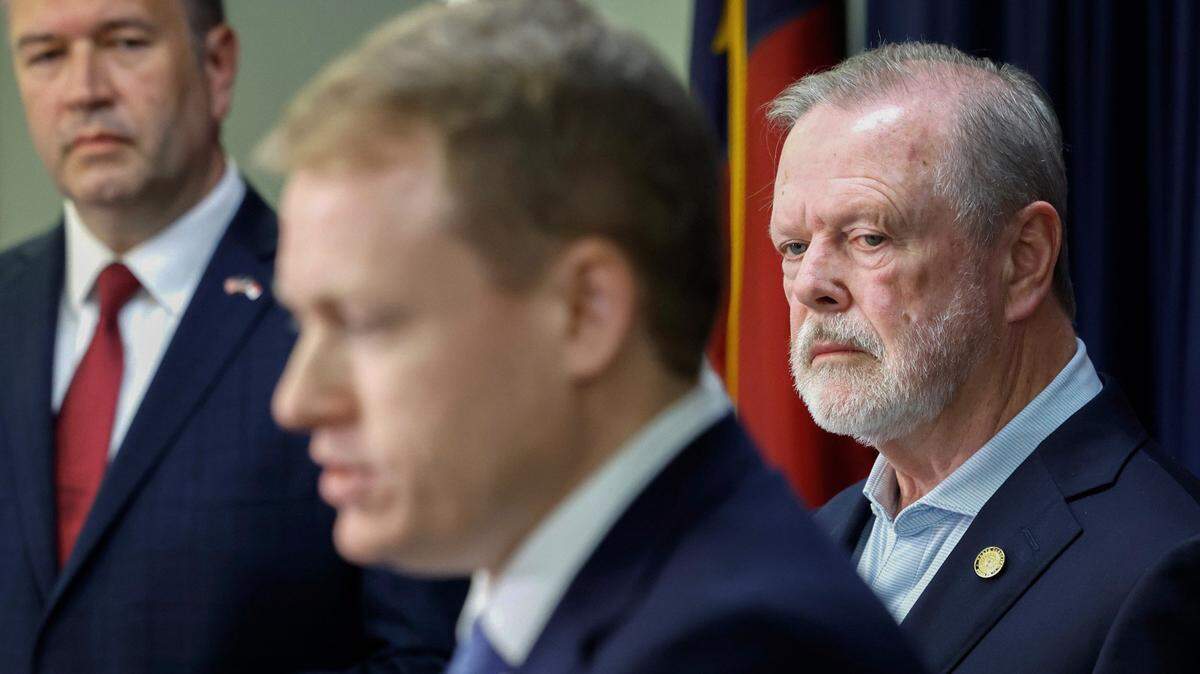
March 2026: Gov. Josh Stein, Senate leader Phil Berger and House Speaker Destin Hall announce the formation of a bipartisan Blue Ribbon Commission on Public Education. The commission will examine teacher training and student advancement, administrative operations, educational leadership and accountability.
April 2026: N.C. Supreme Court rules 4-3 to throw out the 2022 decision and the Leandro plan. The court also dismisses the lawsuit.