Do dead snakes bite? Are baby copperheads more dangerous? 15 beliefs fact-checked
AI-generated summary reviewed by our newsroom.
- Snakes start to become more active in spring, so we asked experts to debunk myths.
- In North Carolina, the creatures aren’t aggressive and won’t chase people.
- Some beliefs are true, including that copperheads are common and dead snakes can bite.
Snakes are slithering around this time of year, and so are myths surrounding their behavior.
In North Carolina, the creatures start becoming more active in the spring. So, we figured now would be a good time to find out whether common beliefs about snakes are true.
We turned to experts, who shared their thoughts about topics ranging from snake repellents to the prevalence of venomous copperheads. Here’s what we learned from them and through our other reporting.
Myth #1: Snakes are aggressive.
Verdict: False
There’s a notion that snakes are mean. But “nothing could be further from the truth,” Jeff Beane, collections manager for herpetology at the N.C. Museum of Natural Sciences in Raleigh, told The News & Observer in a Wednesday, April 1 phone interview.
“A snake’s only going to bite a human if a human steps on it, picks it up, sticks a body part up in its face, that sort of thing,” Beane said. “That’s self defense. That’s not aggression.”
Myth #2: Snakes can bite you if they’re dead.
Verdict: True
Even though it sounds like a tall tale, a snake can bite you after it’s dead.
“Bites sometimes happen because a person beheaded a snake then quickly went to pick it up, not knowing snakes can whip their heads around (even from just a few inches of remaining neck) and deliver a quick bite to the hand,” The N&O previously reported. “Snakes can bite for up to an hour after being beheaded.”
So while many experts say you shouldn’t kill snakes, be cautious around ones you think are dead.
Myth #3: Repellents can keep snakes out of your yard.
Verdict: False
Mothballs and other products claiming to keep snakes out of people’s yards don’t work.
“If you put a snake in a small, enclosed compartment with one of these repellents, it might be very discomforting,” Beane said. “But if you just spread it around your yard, it is just going to blow away. The snake’s probably not going to notice it.”
Snakes will likely come near your home in North Carolina, unless you live in a high-rise building or have a paved yard.
But you may be able to reduce your chances of encountering snakes if you make your outdoor space less inviting to one of their main prey, rodents. To do this, you can avoid putting out food and scale back on brush in your yard, Falyn Owens, wildlife extension biologist with the N.C. Wildlife Resources Commission, told The N&O in a Wednesday, April 8 phone interview.
Myth #4: Copperheads want to bite you.
Verdict: False
Copperheads don’t pose much of a threat when people leave them alone. They use their venom on animals they want to eat, and humans are too big to be considered prey, the wildlife commission wrote on its website.
“It is not advantageous for snakes to waste venom — it’s metabolically expensive to make, so they don’t want to bite anything other than prey items,” Beane previously told The N&O.
Myth #5: If you see one snake, another is close.
Verdict: Sometimes true
Snakes don’t move around together, but some circumstances bring them closer to one another.
“Most of the time, snakes are solitary, but there are certainly times when they may be encountered in pairs or larger groups,” Beane previously told The N&O. “Obviously, this would include during mating, which requires at least one male and one female, so it is not uncommon to see a pair together during mating season.”
Snakes tend to mate during the warmer months. But the animals also may be near each other if an area has food, shelter or other resources, according to Beane and Dr. Ben German, a snake expert and emergency physician at WakeMed.
Myth #6: All snakes with triangle-shaped heads are venomous.
Verdict: False
Some people believe every snake with a triangle-shaped head is venomous, and those with other head shapes are harmless. But that leaves out some important considerations.
“A lot of our non-venomous snakes will flatten their jaws and create a triangular shape to their head,” Owens said. “If they feel threatened, if they’re being pressed by a big, scary animal like a human, and they want to be left alone, they will flatten their heads and flatten their jaws in a way that makes their heads look triangular.”
For example, the Eastern coral snake — which is rare in North Carolina — is venomous but doesn’t have a triangle-shaped head.
Myth #7: All snakes that rattle are rattlesnakes.
Verdict: False
North Carolina is home to three types of rattlesnakes. But just because you hear a rattling sound, that doesn’t mean it comes from one of those snakes, the wildlife commission said.
Similar to harmless snakes that form their heads into a triangle shape, some non-venomous snakes shake their tails. They do this to scare off predators, The N&O previously reported.
Myth #8: Baby copperheads are more dangerous than adults.
Verdict: It’s complicated.
There’s a notion that younger copperheads inject more venom than adults. The reasoning is that the babies can’t control their venom, but experts have been split on whether that may be true.
Compared to babies, adult copperheads have more venom, longer fangs and better chances at striking prey. But the venom from the young ones can sometimes be more toxic, depending on what they eat.
“If I had the choice between getting bit by a baby copperhead, usually eight to ten inches, versus a full-size adult, which can be three to four feet, it would be a very easy decision. I’d always take the smaller snake,” German previously told The N&O.
“The quantity is so much greater in an adult snake, that’s what really gets you. Just the amount of toxins being injected.”
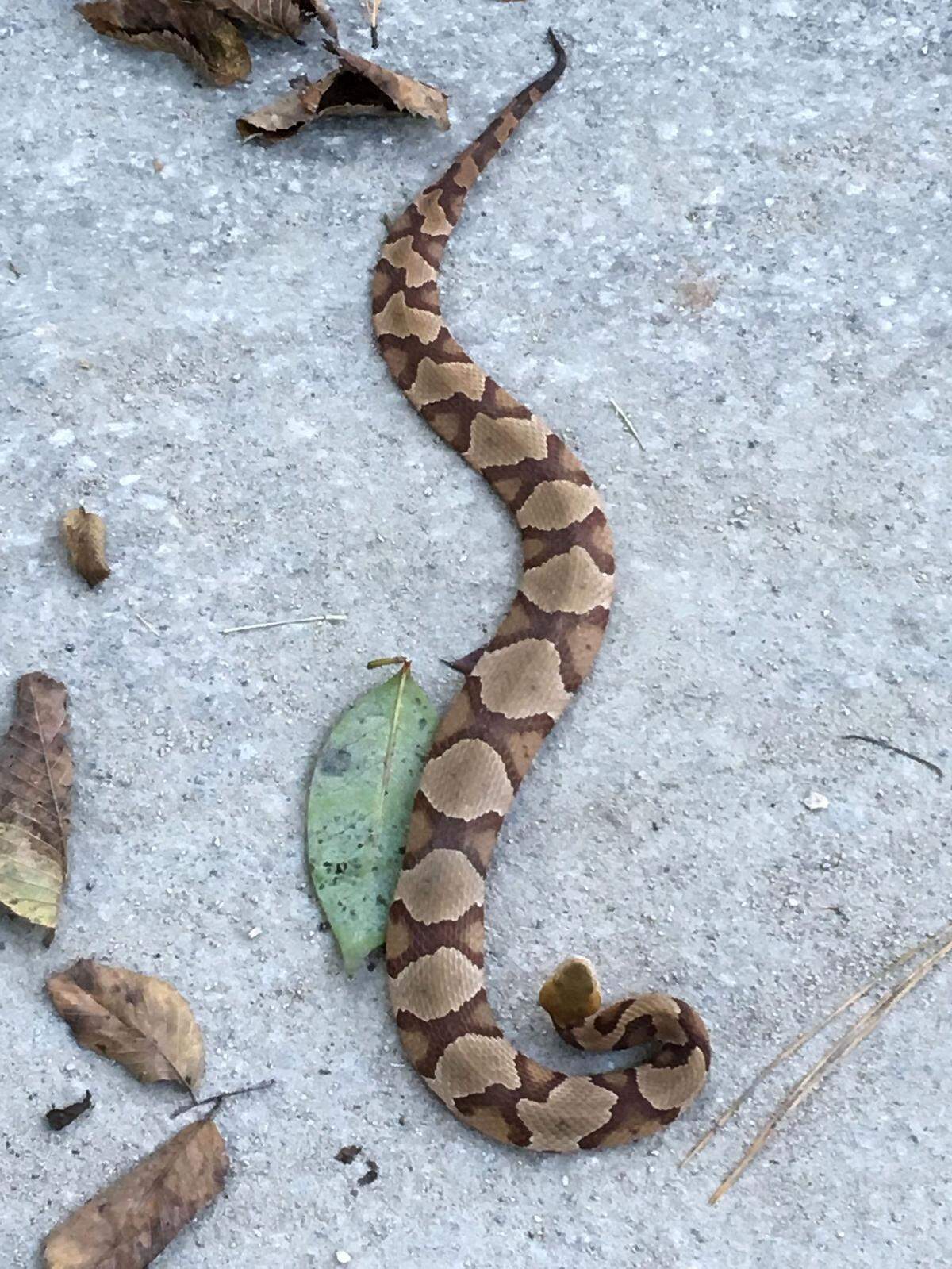
Myth #9: All snakes with patterns are copperheads.
Verdict: False
Copperheads are known for having hourglass-shaped bands on their bodies. But we can debunk the belief that all snakes with patterns are from that species.
“We even have a lot of snakes that have different patterns when they’re young than when they’re adults,” Owens said. “So there’s kind of a lot of snake patterns out there, and assuming that just because it has a pattern, it must be a copperhead or it must be venomous, is very untrue.”
Myth #10: Snakes use their tails to sting people.
Verdict: False
In North Carolina, many snakes have tails that are pointy at the end. But that’s not the part of the snake that can inflict pain.
“Their tails are harmless and not strong enough to break the skin of a person,” the N.C. State Extension wrote on its website. “No snake possesses a stinger. Venomous snakes use fangs, which are modified teeth, to inject venom into prey.”
Myth #11: Copperheads are common in North Carolina.
Verdict: True
Copperheads are the venomous snakes you’re most likely to encounter in North Carolina. Unlike other snakes that live far from people, the species is comfortable living close to humans, The N&O previously reported.
“Copperheads are the only venomous snake that can be found pretty much anywhere across the state, whether it’s the coast or the mountains or the Piedmont, the middle of a city or the middle of a really, really natural area, copperheads are very common,” Owens said.
The snakes tend to mind their business. But due to their prevalence, copperheads are believed to account for more than 90% of venomous snake bites in North Carolina.
Myth #12: ‘The only good snake is a dead snake.’
Verdict: False
Every type of snake is important to the North Carolina ecosystem.
“Rather than trying to eliminate all snakes from an area, the best way to prevent snake bites is to learn how to accurately identify copperheads and keep a respectful distance from any snakes you do come across,” Owens previously told The N&O.
Though snakes tend to avoid people, experts said many bites happen when people try to confront the creatures. So, it’s best to appreciate them from afar.
Myth #13: Construction pushes snakes into nearby areas.
Verdict: False
Construction projects often kill snakes, rather than pushing them into other neighborhoods.
“You don’t see a huge exodus of snakes from one area into (another) during construction projects, and most snakes will try to hunker down and stay safe during the construction,” The N&O previously reported. “But industrial equipment kills many that stick around.”
One caveat is that small numbers of snakes can manage to get out of construction zones. Those snakes may mate in their new locations or move back to their original turf once construction is over, German said.
Myth #14: Snakes chase people.
Verdict: False
It turns out, the behaviors that people interpret as snakes chasing them are often misunderstandings. The animals, which have poor eyesight, may confuse humans as shelter or try to get past people to get where they need to go.
“In every case, once the snake realizes that you’re a person, a human being and a live animal, it’s going to either sort of crawl past you, or change directions and go the other way, because they really have no interest in interacting with us at all,” Owens said.
Myth #15: Only venomous snakes have teeth or fangs.
Verdict: False
All snakes have teeth. So even if you think one is non-venomous, you may get bitten.
“If you think about it, snakes don’t have arms or legs, and they can’t grab their prey with claws, like a cat might,” German previously told The N&O. “They typically do rely on their teeth to at least hold their prey, that way it can’t get away.”
Portions of this story were previously published in The News & Observer.